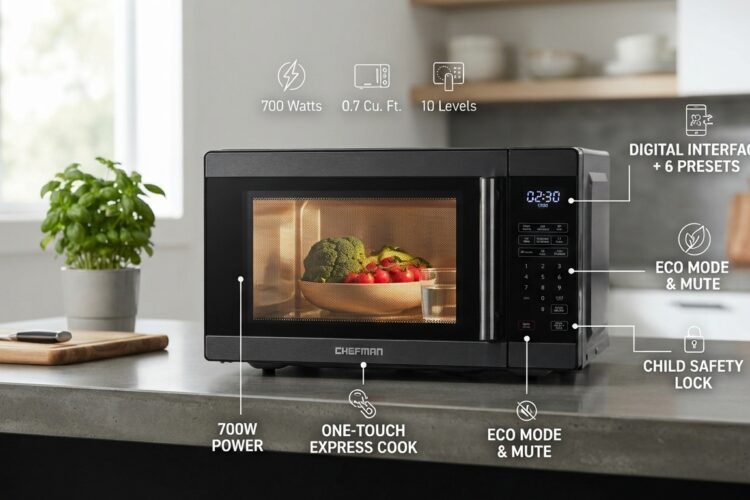
Microwaves have quietly become one of the most relied-upon appliances in modern kitchens. Whether reheating last night’s leftovers, softening butter for a recipe, or popping a quick bag of popcorn during a movie night, this small appliance handles more daily tasks than most people consciously notice. Among the many compact microwave options available today, the Chefman Countertop Microwave Oven, with its 0.7 cubic foot capacity and 700-watt power output, has drawn attention from shoppers looking for a space-conscious, straightforward appliance for smaller kitchens, dorm rooms, offices, or secondary cooking areas.
This article takes a closer look at what this microwave offers, how it might fit into different lifestyles, and what factors are worth thinking through before deciding whether it matches your needs. Rather than presenting this as a definitive verdict, the goal here is to walk through the practical realities of owning and using a compact microwave like this one, based on its listed specifications and typical use cases for appliances in this category.
Key Features of the Chefman Countertop Microwave
Compact 0.7 Cubic Foot Capacity
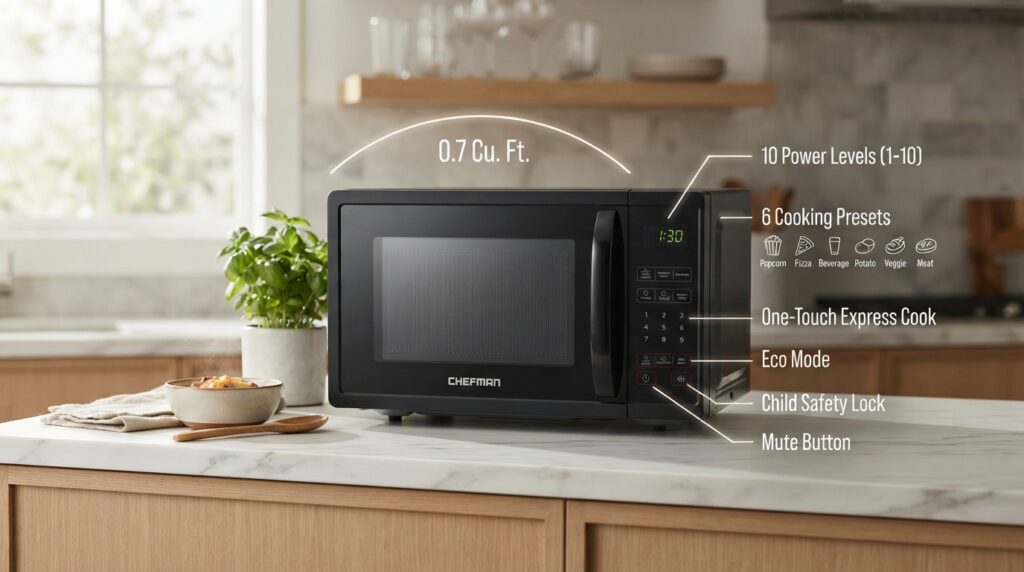
One of the more notable aspects of this microwave is its size. At 0.7 cubic feet, it falls into the “compact” or “small” category of microwaves, making it a reasonable fit for kitchens where counter space is limited. This size class is commonly found in studio apartments, college dorms, RVs, break rooms, and as a secondary microwave in larger homes. While it may not accommodate oversized casserole dishes or large dinner plates, it’s generally sized to handle everyday items like mugs, small bowls, standard dinner plates, and typical microwave-safe containers.
700 Watts of Cooking Power
The unit operates at 700 watts, which is on the lower-to-moderate end of the wattage spectrum for household microwaves. Wattage affects how quickly and evenly food heats up. Lower-wattage microwaves like this one tend to heat food a bit more gradually compared to higher-wattage models (which often range from 1000 to 1200 watts). This isn’t necessarily a drawback — in fact, some users prefer lower wattage for more controlled reheating, especially with delicate foods that can overcook or turn rubbery under high heat. It does mean that cooking times listed on packaged foods may need slight adjustments, since most packaging assumes a higher-wattage appliance.
10 Power Levels
Having ten distinct power levels gives users a reasonable degree of control over how food is heated. Instead of a simple on/off or high/low setting, this range allows for more nuanced adjustments — for example, using a lower power level to gently melt chocolate or soften ice cream without overheating the edges, while reserving higher levels for reheating denser foods like rice or pasta dishes.
Six Cooking Presets with One-Touch Express Cook
The inclusion of six pre-programmed cooking settings is designed to simplify routine tasks. Rather than manually calculating time and power levels, users can select a preset suited to common foods — this generally includes options like popcorn, pizza, beverages, frozen vegetables, and similar everyday items, depending on how the presets are configured on this particular model. The “One-Touch Express Cook” function appears to allow for quick starts on common time increments, which can be useful for those who want a fast, no-fuss way to begin heating without scrolling through multiple menu screens.
Eco Mode
Eco Mode is a feature aimed at reducing standby power consumption. Many kitchen appliances, microwaves included, draw a small amount of electricity even when not actively in use — largely to power the clock display and internal electronics. An eco mode setting typically dims or disables the display after a period of inactivity, which can contribute to modest energy savings over time. For households conscious about electricity usage or long-term appliance efficiency, this is a small but meaningful addition.
Child Safety Lock
Households with young children often look for appliances that include a safety lock feature, and this microwave includes one. When activated, this function is intended to prevent the microwave from being started accidentally or by a child without adult supervision. It’s a straightforward but valuable feature for family kitchens, shared living spaces, or homes where curious hands might otherwise interfere with the controls.
Mute Button
Not every kitchen appliance needs to announce itself loudly, and the mute function on this model allows users to silence the beeping tones that typically accompany button presses and cooking completion alerts. This can be particularly useful in shared living environments, offices, nurseries, or for anyone who simply prefers a quieter kitchen environment during early mornings or late nights.
How It Can Be Used
A compact microwave like this one tends to lend itself well to a range of everyday cooking and reheating tasks. Here are some practical ways it might be used:
Reheating leftovers — One of the most common microwave functions, reheating works well for items like rice, pasta, soups, and cooked vegetables. The multiple power levels help avoid the common problem of unevenly heated food, where the edges are scalding while the center remains cold.
Preparing quick snacks — Popcorn, hot beverages, and simple frozen snacks are well-suited to the preset functions, allowing for consistent results without requiring the user to remember specific time and power settings.
Defrosting frozen items — Lower power settings can be used to thaw smaller cuts of meat, frozen vegetables, or bread products more gently than a high-powered blast, which helps avoid partially cooking the outer layer while the inside remains frozen.
Softening or melting ingredients — Butter, chocolate, and similar cooking ingredients often need gentle, controlled heat, which is where having a range of power levels becomes genuinely useful rather than just a marketing checkbox.
Basic cooking tasks — While not a substitute for a full-sized oven or stovetop, this type of microwave can handle simple cooking jobs like steaming vegetables in a microwave-safe container, cooking certain frozen meals, or preparing single-serving mug recipes.
Who It May Be Suitable For
Given its size, wattage, and feature set, this microwave seems best suited to certain living situations and user needs rather than being a universal fit for every household.
College students and dorm residents often prioritize compact appliances that don’t take up much space and don’t require complicated operation. The straightforward interface and smaller footprint could align well with these needs.
Individuals living alone or in small apartments may find the 0.7 cubic foot capacity sufficient for single-serving meals and everyday reheating tasks, without the bulk of a larger, family-sized microwave.
Office break rooms are another common setting for compact microwaves, particularly in workplaces where the primary use is reheating packed lunches rather than full meal preparation.
Secondary kitchen spaces, such as a garage, basement, home office, or guest suite, can benefit from having a smaller, dedicated microwave that doesn’t require relocating dishes to the main kitchen.
Households with young children may appreciate the child safety lock specifically, as it adds a layer of reassurance in homes where kids might otherwise be tempted to press buttons or attempt to operate the appliance unsupervised.
On the other hand, larger families or those who frequently reheat sizable dishes, big casserole trays, or multiple servings at once might find the compact capacity limiting. In those cases, a mid-size or full-size microwave with a larger interior and higher wattage might be more practical.
Important Things to Consider Before Purchasing
Wattage and Cooking Time Expectations
Because this model operates at 700 watts, cooking and reheating times will generally run longer than what’s printed on many packaged food instructions, which are often calibrated for 1000-watt or higher appliances. This isn’t inherently a downside, but it’s worth factoring into expectations — users may need to experiment with time adjustments for the first few uses of any new frozen meal or snack.
Interior Space Limitations
A 0.7 cubic foot interior is on the smaller side. It’s worth measuring your typical dishware — particularly larger bowls, mugs, or plates — to ensure they’ll comfortably fit and rotate on the turntable without hitting the interior walls.
Countertop and Placement Space
Even compact microwaves need adequate ventilation space around them, particularly near the back and sides, to allow heat to dissipate properly during operation. Before purchasing, it’s a good idea to measure the intended placement area, keeping manufacturer clearance recommendations in mind.
Preset Accuracy for Specific Foods
While preset cooking functions are convenient, they’re generally calibrated for “typical” portion sizes and moisture content. Foods that vary significantly from the assumed standard (extra-large portions, unusually dense items, etc.) may still require manual time adjustments even when using a preset button.
Noise and Alert Preferences
For those sensitive to beeping sounds — whether due to a sleeping baby nearby, an open-plan living space, or simple personal preference — the mute function is a relevant feature to keep in mind, though it’s worth confirming how it functions across different stages of the cooking cycle (start beep vs. completion beep, for example).
Energy Efficiency Habits
Eco Mode can help reduce phantom power draw, but its actual impact will vary depending on how often the microwave sits idle with the display active. For most households, the energy savings will be modest rather than dramatic, but it may still align with a broader effort toward mindful energy consumption.
Comparing General Microwave Categories
To put this specific model into context, it helps to understand how compact microwaves generally compare to other common categories on the market.
Compact microwaves (0.5–0.9 cu. ft.) — This category, which includes the Chefman model discussed here, is designed primarily for space efficiency. These units typically range from 700 to 900 watts and prioritize a smaller footprint over larger capacity or higher power. They tend to suit individuals, couples, or secondary-use spaces rather than large households needing to reheat big batches of food.
Mid-size microwaves (1.0–1.5 cu. ft.) — These offer a more balanced middle ground, generally featuring higher wattage (900–1100 watts) and larger interior space, making them suitable for small to medium-sized families. They’re often the standard choice for a primary kitchen microwave.
Full-size and over-the-range microwaves (1.5+ cu. ft.) — These are typically built for larger households or those who cook more elaborate microwave-based meals. Over-the-range models also serve a dual purpose as a range hood, combining ventilation with cooking functionality, though they require more complex installation.
Convection or multi-function microwaves — These combine traditional microwave heating with convection (fan-assisted) cooking, allowing for browning, crisping, and baking functions that standard microwaves can’t replicate. They tend to come at a higher price point and larger size, making them a different category of appliance altogether, better suited to those who want to reduce reliance on a conventional oven.
Each category serves a different practical purpose, and the “right” choice ultimately depends on available space, household size, and how the appliance will primarily be used — whether that’s quick reheating, defrosting, or more involved microwave cooking.
Frequently Asked Questions
Is 700 watts enough for everyday microwave use? For basic tasks like reheating, defrosting, and preparing simple snacks, 700 watts is generally sufficient, though cooking times will run a bit longer compared to higher-wattage models. It’s a reasonable wattage for individual or light household use rather than heavy, frequent cooking.
Will this microwave fit a standard dinner plate? Most compact microwaves in the 0.7 cubic foot range can accommodate a standard-sized dinner plate, though it’s worth checking the interior dimensions and turntable diameter listed in the product specifications to be certain, particularly for oversized or oddly shaped dishware.
How does the child safety lock work? Typically, activating the safety lock disables the control panel until it’s manually deactivated, preventing the microwave from being started accidentally. Exact activation steps can usually be found in the included user manual.
Does Eco Mode affect cooking performance? No, Eco Mode is generally related to standby power consumption and display settings rather than the actual cooking or heating performance of the unit.
Can the presets be adjusted if the food needs more or less time? In most microwaves with preset functions, including models like this one, users can typically add additional time manually after selecting a preset if the food isn’t fully heated, offering some flexibility beyond the fixed preset duration.
Is this microwave suitable for a family kitchen? It can work as a supplementary microwave or for smaller portions, but families who frequently reheat larger dishes or cook for several people at once may find a larger-capacity, higher-wattage model more practical as a primary kitchen appliance.
What’s the benefit of having a mute button on a microwave? It allows users to silence operational beeps, which can be helpful in quiet environments, around sleeping infants, in shared workspaces, or simply for those who prefer a less noisy kitchen experience.
Final Thoughts
Choosing a microwave often comes down to matching an appliance’s size, power, and features to the realities of daily use rather than chasing the most advanced or largest option available. The Chefman Countertop Microwave Oven, with its 0.7 cubic foot capacity, 700-watt output, and thoughtful additions like Eco Mode, a child safety lock, and a mute function, appears designed with smaller households, individual users, and secondary kitchen spaces in mind. Its preset cooking options and multiple power levels aim to simplify everyday tasks like reheating and defrosting, while its compact size makes it a reasonable fit for kitchens where counter space is at a premium.
As with any appliance purchase, it’s worth weighing your specific needs — household size, typical dish sizes, noise preferences, and available counter space — against what this model offers. For those specifically seeking a space-saving, straightforward microwave for everyday tasks, this appears to be a relevant option worth further investigation.