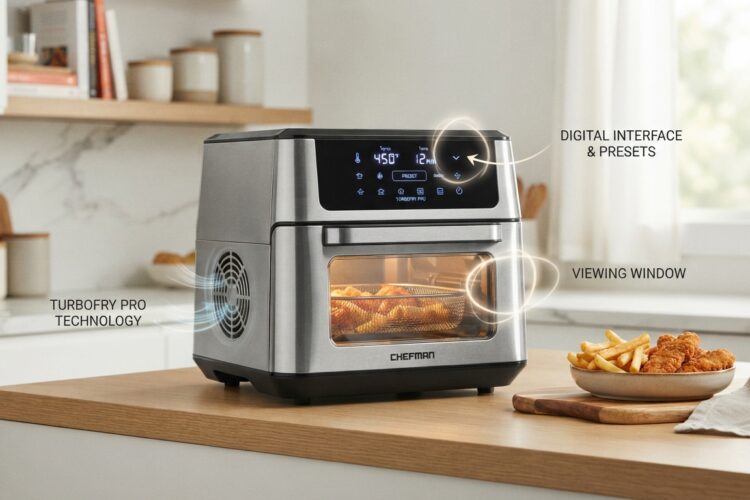
Air fryers have moved well past the point of being a passing kitchen trend. For a lot of households, they’ve quietly taken over duties that used to belong to the oven, the toaster, the deep fryer, and even the food dehydrator tucked away in the back of a cabinet. As more brands compete for counter space, shoppers are left comparing wattages, basket shapes, and temperature ranges that all start to blur together after a while.
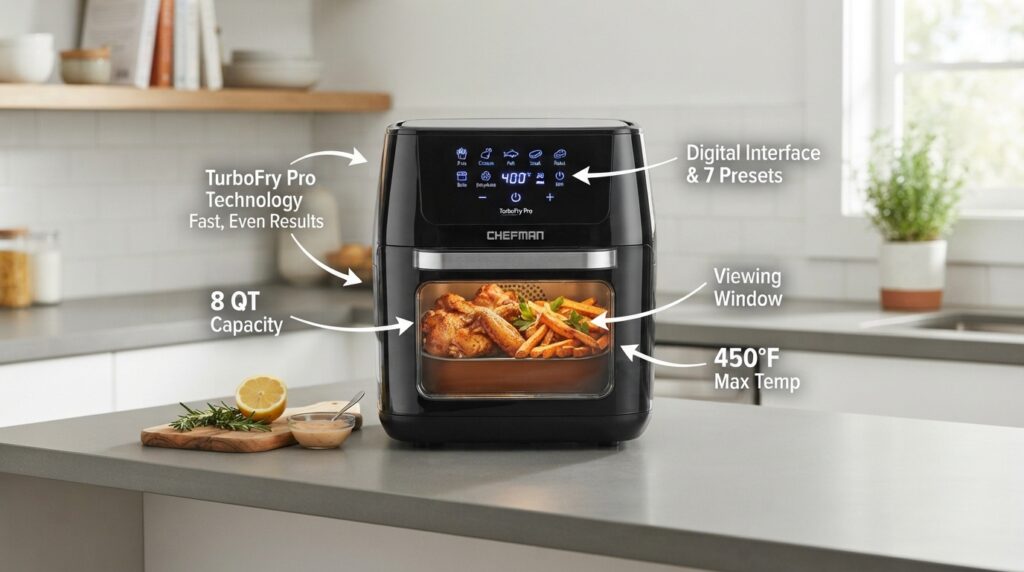
The Chefman Crispinator Air Fryer is one of the newer entries in this crowded category, built around an 8-quart capacity, a 450°F maximum temperature, and what Chefman calls TurboFry Pro Technology. It’s marketed as a 7-in-1 appliance, meaning it’s designed to handle more than basic air frying — think baking, broiling, dehydrating, reheating, and beyond, all from a single countertop unit.
This article walks through what the Crispinator actually offers, how it might fit into different kitchens and cooking habits, and what’s worth thinking about before deciding whether it’s the right appliance for your household. Nothing here is meant as a personal endorsement or a firsthand account — instead, it’s a breakdown of the product’s stated features and how those features tend to translate into real-world cooking, based on how this general category of appliance typically performs.
Key Features of the Chefman Crispinator Air Fryer
TurboFry Pro Technology and High-Heat Cooking
At the center of the Crispinator’s design is its TurboFry Pro system, which pairs a high-speed DC motor with a top temperature of 450°F. That’s notably higher than the 400°F ceiling found on many entry-level air fryers. The extra 50 degrees matters more than it might sound like on paper — foods like chicken wings, steak, and thick-cut vegetables often benefit from that added heat because it helps develop a firmer, more browned exterior in less time, rather than leaving food merely warmed through with a soft surface.
The unit’s temperature range spans from 90°F up to 450°F, which gives it enough flexibility to handle low-and-slow tasks like dehydrating fruit as well as high-heat jobs like crisping frozen appetizers.
7-in-1 Functionality
Rather than being limited to a single air-fry setting, the Crispinator includes seven cooking functions. Based on Chefman’s published specifications, these typically include air frying, baking, broiling, dehydrating, reheating, and keeping food warm, in addition to standard convection-style cooking. Having this range built into one machine means it can realistically stand in for several smaller appliances — a toaster oven for reheating, a dehydrator for dried fruit or jerky, and a countertop convection oven for baking small batches.
This kind of multi-function design tends to appeal to people who are trying to consolidate kitchen gadgets rather than add another single-purpose device to an already crowded counter.
8-Quart Capacity
Capacity is one of the more practical specs to pay attention to, since it directly affects how much food you can cook in a single batch. At 8 quarts, the Crispinator’s basket is on the larger end for a countertop air fryer, generally suited to preparing a whole chicken, a full sheet of vegetables, or enough fries and wings for a family of four to six without needing to cook in multiple rounds.
Larger capacity also means a larger footprint, which is worth factoring into your kitchen’s available counter and storage space — something we’ll come back to later in this article.
Nonstick Ceramic-Coated Basket
The basket and accompanying rack use a ceramic-based nonstick coating rather than the traditional PTFE nonstick coatings found in older cookware. Ceramic coatings are often chosen by manufacturers because they don’t rely on PFAS (a group of synthetic chemicals that have drawn increased scrutiny in cookware manufacturing over the past several years). In practical terms, a ceramic coating is generally intended to make food release and cleanup easier, though like most nonstick surfaces, it benefits from gentle utensils and mild cleaning to preserve its lifespan over time.
Viewing Window and Interior Light
A built-in window on the front of the basket, paired with an interior light, allows you to check on food’s progress without opening the drawer and interrupting the cooking cycle. This is a small but genuinely useful feature for anyone who’s ever pulled a basket out repeatedly to check doneness, only to lose heat and extend the total cooking time as a result.
Shake and Flip Reminders
Even cooking in an air fryer often depends on redistributing food partway through the cycle, especially with foods like fries or wings that can crisp unevenly if left untouched. The Crispinator includes an LED-based reminder system that alerts you partway through cooking, prompting a shake or flip at the appropriate moment rather than requiring you to track the timing yourself.
Design and Build
The Crispinator has a lower-profile, horizontal design compared to some taller, more vertical air fryer models. This style tends to prioritize stability and a more compact vertical footprint, even though the overall unit takes up a bit more counter depth. The appliance also carries a Red Dot Design Award, an industry recognition given for product design rather than a claim about cooking performance — worth noting as a design distinction rather than a functional one.
On the safety side, the unit includes an automatic shutoff feature, which stops the cooking cycle when the timer ends or the basket is removed, and it holds relevant electrical safety certifications common to countertop kitchen appliances sold in North America.
How the Crispinator Can Be Used in Everyday Cooking
One of the more appealing aspects of a multi-function air fryer is the range of meals it can realistically handle across a typical week, rather than being limited to one type of dish.
Weeknight proteins. Chicken thighs, salmon fillets, pork chops, and similar cuts tend to do well in an air fryer because the circulating hot air cooks them relatively quickly while helping the exterior brown. The higher 450°F ceiling on this model may be useful for cuts that benefit from a firmer sear, such as steak tips or thicker chicken breasts.
Frozen and packaged foods. Frozen fries, mozzarella sticks, chicken tenders, and similar items are a common starting point for most air fryer owners, largely because these foods are forgiving and quick to prepare. An 8-quart basket allows for a full bag of fries or a family-sized batch of frozen appetizers without needing to cook in shifts.
Roasted vegetables. Brussels sprouts, cauliflower, sweet potatoes, and other vegetables that typically benefit from high, dry heat in a conventional oven can often be prepared faster in an air fryer, using a fraction of the oil that pan-roasting might otherwise require.
Baking in small batches. The bake function opens the door to items like small-batch cookies, muffins, or even a modest personal-sized cake, using oven-safe bakeware sized to fit the basket. This won’t replace a full-size oven for larger baking projects, but it can be convenient for smaller quantities or when you don’t want to heat up a full-size oven for a small dish.
Dehydrating. With a temperature range that dips down to 90°F, the Crispinator can be used to dry fruit slices, vegetable chips, or homemade jerky over a longer cooking cycle — a task that typically requires a dedicated dehydrator on its own.
Reheating leftovers. Reheating pizza, fried foods, or takeout in an air fryer tends to restore some crispness that a microwave usually can’t, since the hot circulating air helps re-crisp the exterior rather than just steaming it.
Batch cooking and meal prep. The larger basket size lends itself to preparing multiple servings at once, which can be useful for anyone doing weekly meal prep or cooking for a larger household.
Who This Air Fryer May Be Suitable For
Given its feature set, the Crispinator tends to align well with a few particular types of cooks and households, though it’s worth being realistic about who it may be less suited for as well.
Families and larger households who regularly cook for four or more people may appreciate the 8-quart capacity, since it reduces the need to cook food in multiple batches — a common frustration with smaller 2- to 4-quart air fryers.
People trying to consolidate kitchen appliances. Anyone currently juggling a separate toaster oven, dehydrator, and air fryer might find value in a single 7-in-1 unit that covers most of that ground, provided the functions meet their specific needs.
Home cooks who prioritize visibility and monitoring. The viewing window and interior light are aimed at people who like to keep an eye on food without interrupting the cooking cycle — useful for those still learning how a new appliance behaves with different foods.
Households looking to reduce oil use in daily cooking. Air frying in general uses significantly less oil than deep frying, which may appeal to anyone trying to cut back on added fats without giving up crispy textures entirely.
On the other hand, individuals or couples with smaller households may find an 8-quart unit larger than necessary, both in terms of counter footprint and the practicality of cooking small portions in a bigger basket. Kitchens with limited counter or storage space should also weigh the unit’s dimensions carefully before purchasing, since a low-profile design still requires a reasonably sized flat surface.
Important Things to Consider Before Buying
No appliance is a universal fit, and it’s worth thinking through a few practical details before deciding whether this particular air fryer suits your kitchen.
Counter space and storage. An 8-quart air fryer with a horizontal design takes up more counter real estate than compact 2- to 4-quart models. If your kitchen counter space is limited, it’s worth measuring the area you have available and comparing it against the unit’s published dimensions before assuming it will fit comfortably.
Basket and rack care. While the basket and rack are generally listed as top-rack dishwasher safe, ceramic nonstick coatings — like most nonstick surfaces — tend to last longer with gentler care over time. Many manufacturers of ceramic-coated cookware note that hand-washing with a soft sponge can help preserve the coating’s nonstick properties for longer, even if dishwasher use is technically supported.
Learning the controls. The Crispinator uses a dial-based interface rather than a touchscreen with one-touch presets, which some users may find more tactile and durable over time, while others may prefer the simplicity of preset buttons found on other models. It’s a matter of personal preference rather than one approach being objectively better.
Single-basket design. Like most traditional air fryers, this is a single-basket unit rather than a dual-zone design. That means it doesn’t allow you to cook two different foods at two different temperatures simultaneously — a feature found on some newer multi-basket air fryers. If that kind of flexibility matters to your cooking style, it’s a distinction worth noting.
Noise and ventilation. Air fryers rely on a fan-driven convection system, which produces a certain amount of operating noise. It’s a good idea to keep the unit a few inches away from walls or cabinets to allow for proper airflow and heat dissipation during use.
Realistic expectations around health claims. Air frying does typically use less oil than deep frying, but it isn’t a guarantee of a “healthy” meal outcome on its own — that still depends heavily on the ingredients and portions you choose to cook.
How This Type of Air Fryer Compares to Other Categories
Rather than comparing this specific model against individual competing products, it can be more useful to understand how it fits within the broader landscape of air fryer types currently on the market.
Compact basket-style air fryers (2–4 quarts). These are typically aimed at individuals, couples, or small households with limited counter space. They heat up quickly and are easy to store, but they often require cooking in multiple batches for larger meals — something an 8-quart unit like the Crispinator is designed to avoid.
Large single-basket air fryers (7–10 quarts). This is the category the Crispinator falls into. These models prioritize batch size and are generally better suited to families or anyone who regularly cooks larger portions. The tradeoff is a bigger footprint and, in some cases, a longer preheat time due to the larger internal volume.
Dual-basket or dual-zone air fryers. These models divide the cooking space into two separate compartments, allowing different foods to cook at different temperatures or times at once. They can be convenient for preparing a full meal with mismatched cook times, though each basket is typically smaller than a single large-capacity basket, and the overall unit can be bulkier.
Oven-style or toaster-oven-style air fryers. These larger units use trays and racks rather than a pull-out basket, often with a door that opens outward like a small oven. They tend to offer more versatility for baking multiple items at once but usually take up considerably more counter and storage space than basket-style models.
Each category involves tradeoffs between capacity, footprint, versatility, and ease of use, so the “right” choice really depends on household size, available kitchen space, and how many different cooking functions you expect to use regularly.
Frequently Asked Questions
Is the Chefman Crispinator suitable for a small household? It can be used by smaller households, but its 8-quart capacity and larger footprint are generally better suited to families or anyone who regularly cooks bigger batches. Smaller households without a need for large-batch cooking may find a more compact model easier to store and manage.
Can it replace a dehydrator entirely? The dehydrate function and low-temperature range (down to 90°F) make it capable of drying fruits, vegetables, and similar foods, though dedicated dehydrators with multiple stacked trays may still offer more surface area for larger dehydrating projects.
Is the ceramic coating different from traditional nonstick coatings? Yes. Ceramic coatings are generally formulated without PFAS chemicals, which is a distinction some shoppers specifically look for compared to older-style nonstick coatings. Like most nonstick surfaces, though, care with utensils and cleaning methods can affect how long the coating performs well.
Does the higher 450°F max temperature make a noticeable difference? A higher maximum temperature can help certain foods, particularly proteins and thicker-cut vegetables, achieve more browning and a firmer exterior in less time compared to air fryers capped at 400°F. The practical difference will vary depending on what you’re cooking.
Does it take up a lot of counter space? Given its 8-quart capacity, it has a larger footprint than compact air fryers, though its low-profile design is intended to keep the vertical height more manageable than some taller models. Checking the unit’s published dimensions against your available counter space is a reasonable step before purchasing.
Are the basket and rack dishwasher safe? They’re generally listed as top-rack dishwasher safe, though hand-washing is often recommended by nonstick cookware manufacturers as a way to help preserve the coating over a longer period of regular use.
What’s the benefit of the viewing window? It allows you to visually check on food progress without opening the basket, which helps avoid unnecessary heat loss and interruptions to the cooking cycle — particularly useful while you’re still learning how different foods cook in the unit.
Final Thoughts
The Chefman Crispinator Air Fryer brings together a handful of features — a higher 450°F temperature ceiling, a sizable 8-quart basket, seven cooking functions, and a ceramic-coated nonstick surface — that collectively position it as a family-oriented, multi-purpose countertop appliance rather than a simple one-note air fryer. Its added visibility features, like the viewing window and interior light, are small conveniences that can make a noticeable difference in day-to-day use, while its larger capacity is best suited to households that regularly cook bigger batches rather than single servings.
As with any kitchen appliance, the right fit really comes down to your own cooking habits, household size, and available counter space. If the combination of higher heat, larger capacity, and multi-function versatility lines up with what you’re looking for, it may be worth a closer look.